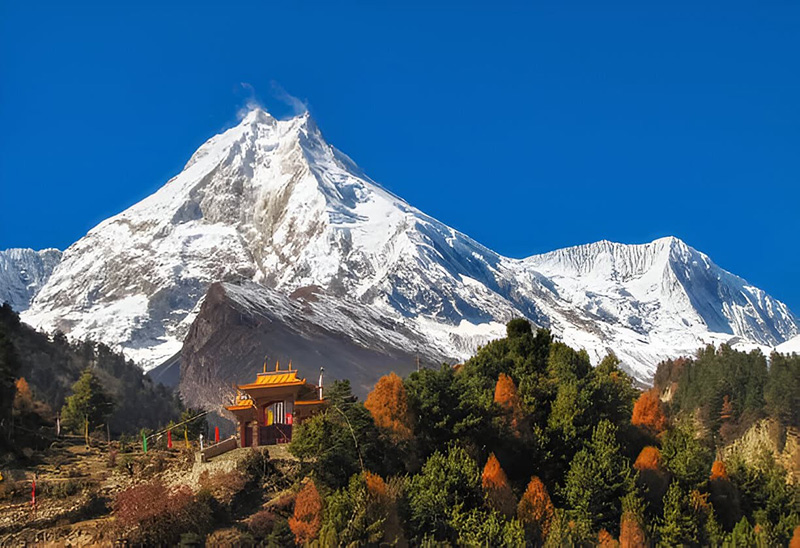
Trekking in Dolpo Region
Discover Nepal’s Most Remote and Magical Wilderness
Peter Matthiessen traveled through Dolpo in 1973, following the naturalist George Schaller on a snow leopard survey across the high plateaus of western Nepal. The book he wrote about the journey — The Snow Leopard — became one of the great works of American nature writing, and it introduced the Dolpo region to a global audience that had no other way of knowing such a place existed. Decades later, the French filmmaker Eric Valli returned to the same high valleys and made Himalaya — a film about the annual salt caravan that the Dolpa people drive across the mountain passes between their plateau villages and the lowland markets — which was nominated for the Academy Award for Best Foreign Language Film in 1999. The film was shot almost entirely in Dolpo. The faces in it are the faces of the people who live there. Two works of art from two different disciplines reached the same conclusion: Dolpo is one of the most extraordinary places on the surface of the earth.
The Dolpo region lies in the far northwestern corner of Nepal, in the Dolpa district of Karnali Province, bordered by Tibet to the north and separated from the rest of the accessible Himalayan world by ranges that kept it effectively closed to foreign visitors until 1989. Even after Nepal opened the region, the government established a two-tier access system — Lower Dolpo accessible with standard national park permits, For trekking in Dolpo Region, it require a special restricted area permit that remains one of the most expensive and logistically demanding trekking permits in Nepal — to limit the number of visitors and protect both the ecology and the culture. The strategy has worked. Dolpo receives fewer trekkers annually than almost any other designated region in the country. For the trekkers who do come, this is the defining feature of the experience: you are in a world that genuinely has not been shaped by the presence of outsiders.
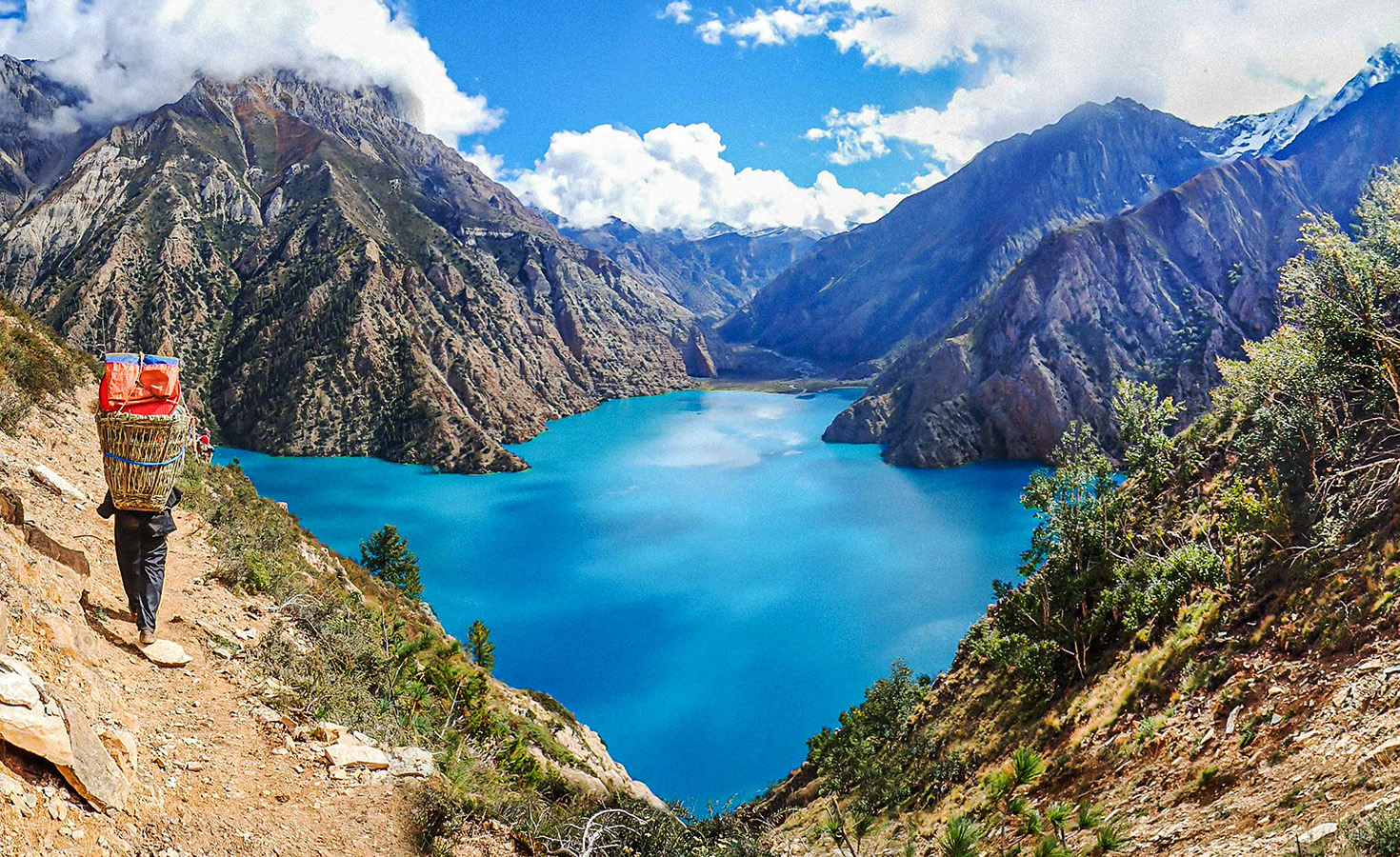
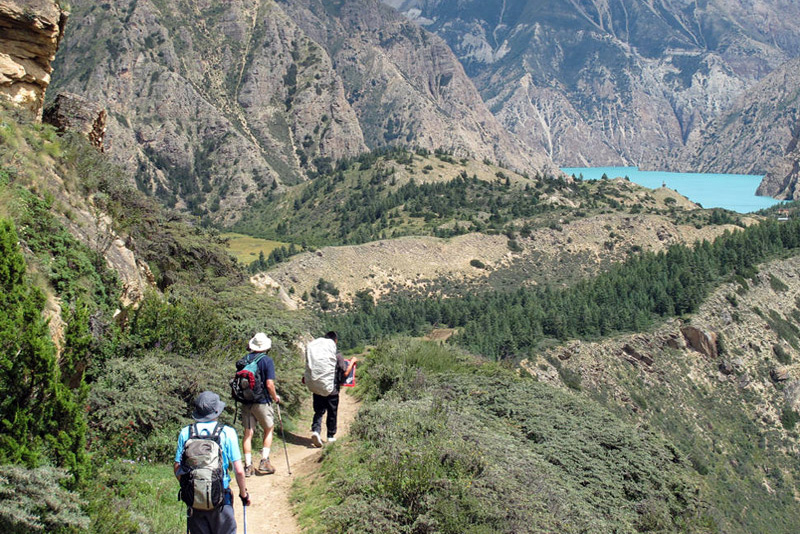
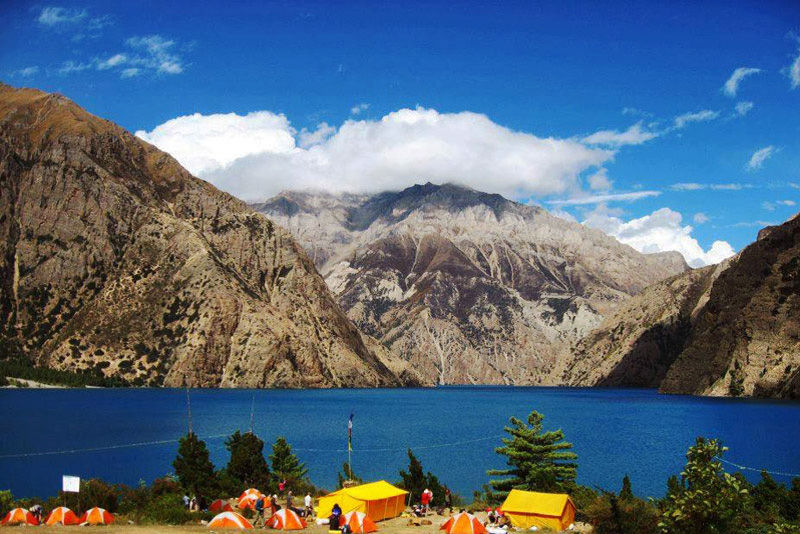
The physical landscape of Dolpo sits on the Tibetan plateau and reflects it. North of the Himalayas, the monsoon fails. The plateau is arid, windswept, and high — most of the inhabited zone lies above 3,500 meters — and the vegetation shifts from juniper scrub to alpine meadow to bare rock as altitude increases. The rivers that drain the plateau cut deep gorges through the sedimentary geology, and the colors of the exposed rock — red, ochre, grey, and the distinctive blue-grey of limestone — shift with the light across the day in a way that painters who have worked here describe as an ongoing revelation. Phoksundo Lake, the turquoise jewel at the heart of Lower Dolpo, sits at 3,611 meters in a bowl of vertical cliffs and holds 145 meters of water of such clarity that it contains no aquatic life whatsoever — the mineral content that creates its extraordinary color also makes it hostile to fish and invertebrates. The lake was designated a Ramsar Wetland of International Importance in September 2007.
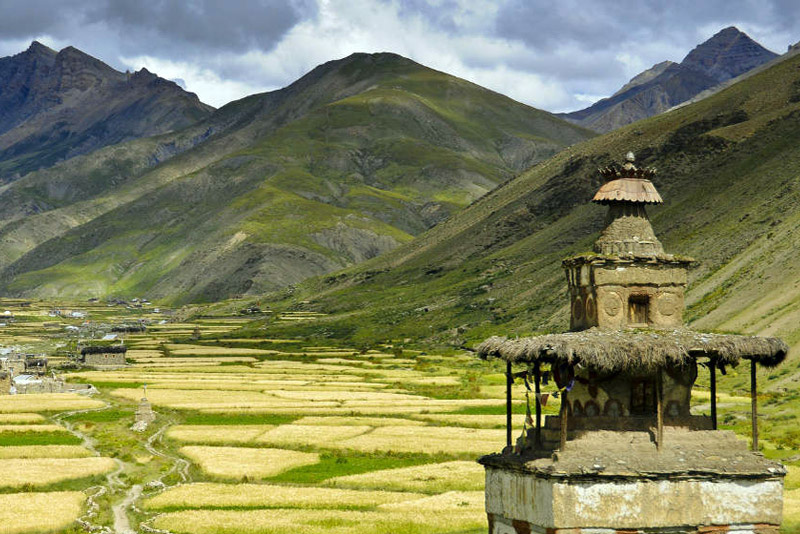
The human culture of Dolpo is one of the last intact expressions of pre-Buddhist Bon religion and Tibetan Buddhist practice coexisting in a single landscape. The Dolpa people — ethnically Tibetan, speaking a Tibetan dialect, practicing both Bon and Buddhist traditions — have inhabited these high valleys for centuries, sustaining themselves through a combination of subsistence farming, yak herding, and the trans-Himalayan trade in salt, wool, and grain that Valli’s film documented. The annual salt caravan, which drove yak trains from the Tibetan plateau salt lakes south to the grain markets of the lowland hill regions, has diminished with road access and economic change, but the culture that produced it — the monasteries, the festivals, the relationship between the Dolpa community and their extreme landscape — persists in a form more complete than in almost any other Himalayan community in Nepal.
At Getaway Nepal Adventure, we offer seven distinct routes across the Dolpo region from the twelve-day Phoksundo Lake Trek accessible to trekkers without high-altitude pass experience, to the twenty-five-day Upper Dolpo Trek that crosses multiple passes above 5,000 meters and requires full expedition camping infrastructure. Every Dolpo route is a serious logistical undertaking. The flights are small and weather-dependent. The trails are remote. The permits require registered agency processing. The camping gear needs to be right. We have been running these routes for years, and our local relationships, equipment standards, and emergency protocols are the foundation on which every Dolpo departure rests.
Trekking in Dolpo Region at a Glance
The Dolpo region covers more route variety than any other restricted-area destination in Nepal — from the accessible Phoksundo Lake teahouse trek to the full Upper Dolpo expedition that crosses multiple 5,000-meter passes over twenty-five days. Understanding which routes are teahouse-supported and which require full camping infrastructure is essential before choosing your itinerary.
| Trek | Days | Style | Max Altitude | Price From |
| Phoksundo Lake Trek | 12 | Teahouse | 3,611m / 11,849ft | USD 1,440 |
| Lower Dolpo Trek | 18 | Teahouse + camping | 4,500m+ passes | USD 2,700 |
| Dolpo Circuit Trek | 18 | Teahouse + camping | 5,000m+ passes | USD 2,745 |
| Rara Lake Trek | 14 | Teahouse | 2,990m / 9,810ft | Request a Quote |
| Jagadulla Lake Trek | 14 | Camping | 4,500m+ | Enquire |
| Dolpo Jomsom Circuit Trek | 25 | Full camping expedition | 5,350m+ passes | USD 2,960 |
| Upper Dolpo Trekking | 25 | Full camping expedition | 5,350m / 17,549ft | USD 3,200 |
Note on accommodation: Lower Dolpo and Phoksundo Lake treks use teahouse lodges where available. Upper Dolpo is a camping-only trek — there are no teahouses above Phoksundo Lake on the upper routes. Full camping equipment, a cook, and an experienced crew are mandatory and are included in all our Upper Dolpo packages.
Upper Dolpo vs. Lower Dolpo: Understanding the Difference
The Dolpo region divides into two distinct zones with different permit requirements, different difficulty levels, and fundamentally different experiences. Getting this distinction clear before booking prevents misaligned expectations and mismatched itineraries.
Lower Dolpo: The Accessible Tier
Lower Dolpo encompasses the southern and more accessible portions of the Dolpa district — principally the Shey Phoksundo National Park, the trail to Phoksundo Lake, and the Tarap Valley and Dho Tarap areas that can be reached without crossing the high plateau passes of the upper region. Access to Lower Dolpo requires the Shey Phoksundo National Park entry permit rather than the full restricted area permit (RAP) required for Upper Dolpo. This substantially reduces the permit cost and administrative complexity.
The centerpiece of Lower Dolpo for most trekkers is Phoksundo Lake — Nepal’s deepest lake, held at 3,611 meters in a natural bowl created by a landslide that occurred 30,000 to 40,000 years ago. The village of Ringmo sits on the landslide dam at the lake’s southern edge, and beyond it, the lake’s outflow drops 167 meters over a waterfall that is one of the most dramatic landscape features in western Nepal. The lake has no aquatic life — its high mineral content makes it biologically barren but visually extraordinary, with a turquoise color that shifts toward emerald and deep blue depending on light and weather. The lake was designated a Ramsar Wetland of International Importance in 2007, recognizing its ecological significance as a pristine high-altitude freshwater system.
The Lower Dolpo route via Phoksundo Lake is the most accessible entry point into the Dolpo world and is appropriate for trekkers who want to experience the landscape, the culture, and the national park without committing to the full expedition demands of Upper Dolpo. The trail is substantially supported by teahouses rather than camping.
Upper Dolpo: The Restricted Expedition
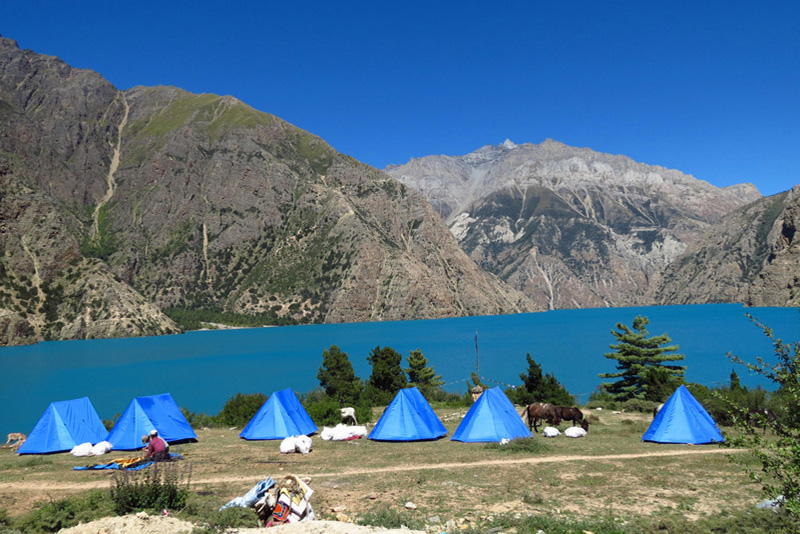
Everything beyond Phoksundo Lake and into the high plateau of the Dolpa district — Shey Gompa, the Tarap Valley, the Saldang and Namgung areas, and the vast trans-Himalayan plateau that borders Tibet — constitutes Upper Dolpo. Access requires a Restricted Area Permit (RAP) obtained through a registered trekking agency, a licensed guide, and full camping infrastructure. There are no teahouses on the upper routes. The trekking party carries everything: tents, cooking equipment, food supplies for multi-day sections, and all camping gear for guides and porters.
Upper Dolpo is one of the most logistically demanding treks in Nepal and is genuinely only suitable for experienced trekkers who have prior high-altitude and multi-pass experience. The routes cross multiple passes above 5,000 meters — including Kang La at approximately 5,350 meters and Jeng La at 5,150 meters — and the remoteness means that helicopter evacuation is the only emergency option if a trekker cannot continue under their own power. The Crystal Mountain pilgrimage circuit and Shey Gompa are the cultural high points of the upper region, and the solitude of the plateau — you may walk entire days without seeing another trekking party — is what experienced Himalayan trekkers travel from across the world for.
Phoksundo Lake: The Jewel of Lower Dolpo
Phoksundo Lake earns its reputation with facts, not marketing. At 3,611 meters above sea level, it is Nepal’s deepest lake — surveys have measured its maximum depth at 136 to 145 meters depending on the methodology used. It is designated a Ramsar site. It has no aquatic life. Its turquoise color is not a photographic enhancement — it is the natural result of extraordinary water clarity combined with mineral content in the surrounding geology, and it changes shade across the day as light angle shifts across the surrounding cliffs.
The Geology and the Legend
The lake exists because of a catastrophic landslide event that occurred between 30,000 and 40,000 years ago, when a collapse of the surrounding cliff faces dammed the valley and created the lake basin. The village of Ringmo, which sits on the southern tip of the lake on the ancient landslide deposit, is the primary human settlement at Phoksundo and the base for all exploration of the lake and its surroundings. Beyond the lake’s southern edge, the outflow drops 167 meters over Phoksundo Falls — one of the tallest waterfalls in Nepal and a significant landmark on the approach trail from Juphal.
The local legend of the lake’s creation is more dramatic than the geology. According to the Dolpa oral tradition, a demoness fleeing from the Buddhist sage Padmasambhava caused the collapse that submerged an ancient village beneath the lake’s waters. Monks at the lakeside monastery conduct daily rituals to contain the demoness’s spirit, and the lake is considered permanently sacred — a place that demands respect from anyone who approaches it. The sacred status means no fishing has ever taken place at Phoksundo, which partly explains why the water remains biologically clean and visually unaltered.
The Ringmo Village and Bon Culture
Ringmo is a small Dolpa community of stone houses and flat roofs, connected to the outside world by the trail from Juphal and, since a road was extended into parts of the district, by occasional vehicle access to points further south. The people of Ringmo practice a blend of Tibetan Buddhism and the ancient Bon religion — the pre-Buddhist spiritual tradition of Tibet that predates the arrival of Buddhism in the region and that survived in its purest form in isolated communities like those of the Dolpa district.
Bon is not simply an older form of Buddhism. It is a distinct spiritual tradition with its own cosmology, its own ritual practices, its own sacred texts, and its own monastery tradition. The Bon monasteries in the Dolpo region — including the one on the eastern shore of Phoksundo Lake and several in the upper plateau villages — follow Bon rather than Buddhist liturgy, and the difference is perceptible in the visual language of their art, the direction of their circumambulation (clockwise in Buddhism, counterclockwise in Bon), and the specific deities represented in their murals and sculptures. For anyone interested in the full range of spiritual practice in the Himalayas, Dolpo is irreplaceable.
Shey Gompa and the Crystal Mountain
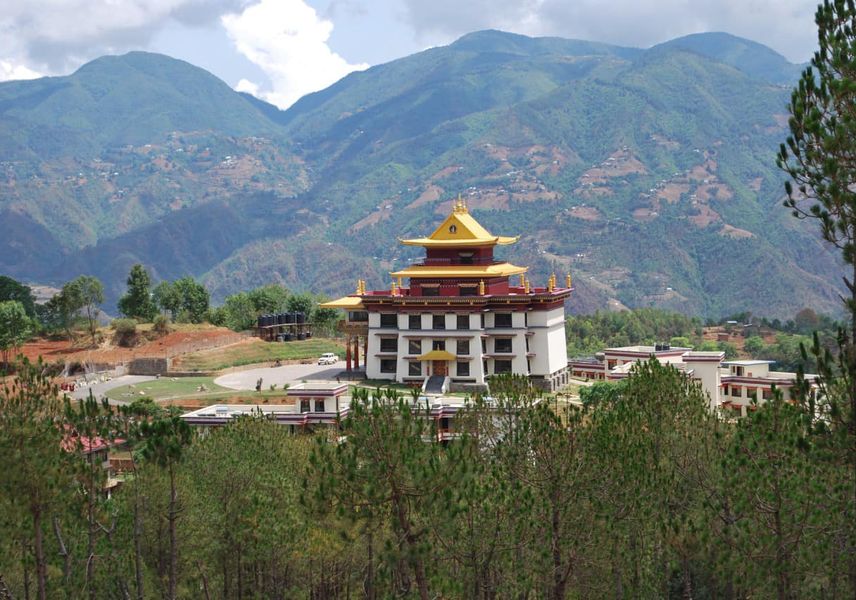
Shey Gompa — formally the Shelri Drugdra, meaning “the roaring of the snow lion from the Shelri mountain” — is the spiritual heart of Upper Dolpo. Founded in the 11th century and located at approximately 4,160 to 4,343 meters on the high plateau north of Phoksundo Lake, the monastery is the destination that the great snow leopard researcher George Schaller and Peter Matthiessen were making for in 1973, and the pilgrimage that generated The Snow Leopard. The monastery is active — monks live and practice here year-round, or as close to year-round as the extreme altitude and winter temperatures allow.
Adjacent to the monastery, the Crystal Mountain — named for the quartz crystals and marine fossils embedded in its cliff faces, which catch light and glitter in a way that made it sacred long before any monastery was built — is a pilgrimage circuit equivalent in local spiritual significance to the circumambulation of Mount Kailash in Tibet. Pilgrims walk the route around the mountain to cleanse accumulated negative karma, and the belief system that animates this practice is Bon rather than Buddhist, reflecting the deep Bon roots of the Dolpa culture. The Crystal Mountain and Shey Gompa together form the most significant sacred complex in the entire Dolpo region and the culmination of all Upper Dolpo trekking routes.
Reaching Shey Gompa requires crossing at least one high pass from the Phoksundo Lake side and navigating the remote plateau trail that connects the lake with the upper Shey valley. It is not a side trip — it is the purpose of the Upper Dolpo Trek. The approach passes through landscapes that shift from the green-tinged lower valleys to the austere grey-brown plateau, with occasional bursts of white from the limestone formations and the blue of distant glaciers on the Tibetan border peaks. Entire days pass without a teahouse, a road, or another trekking party. The silence is not the absence of sound — it is its own presence.
Dolpo Region Trekking Permits 2026: Complete Information
The Dolpo region has the most complex permit structure of any trekking destination we operate. Understanding which permits apply to which routes, and the exact costs for 2026, is essential for accurate planning and budgeting.
Key Rules for Dolpo Permits in 2026
- Upper Dolpo RAP: Must be obtained through a registered trekking agency — cannot be self-obtained.
- Licensed guide: Mandatory for all restricted area (Upper Dolpo) routes.
- Group minimum: Two non-Nepali trekkers required for the Upper Dolpo RAP.
- Lower Dolpo / Phoksundo Lake: No RAP required — Shey Phoksundo National Park permit only.
- Permits cannot be obtained at checkpoints on the trail — buy everything in Kathmandu before departure.
- Trekking beyond your permitted zone: Subject to immediate removal and significant fines.
| Permit | Zone | Cost 2026 | Notes |
| Shey Phoksundo National Park Entry Permit | Lower Dolpo / Phoksundo Lake trek | NPR 3,000 (~USD 22) for foreign nationals; NPR 1,000 SAARC | Required for all treks entering Shey Phoksundo National Park. Available at Nepal Tourism Board, Kathmandu, or at the Dunai park office. Not through DoI. |
| Restricted Area Permit (RAP) — Upper Dolpo | Upper Dolpo all routes | USD 500 per person for first 10 days + USD 50/day thereafter | Must be obtained through a registered agency at the Department of Immigration, Kathmandu. Minimum 2 non-Nepali trekkers. Licensed guide documentation submitted with application. |
| TIMS Card | Both zones (in some variants) | NPR 1,000–2,000 depending on agency/solo status | Verify current requirement with your agency — enforcement has varied in the Dolpo region. Our team confirms requirements per specific itinerary. |
| Annapurna Conservation Area Permit (ACAP) | Dolpo Jomsom Circuit Trek only | NPR 3,000 (~USD 22) | Required only for routes that connect Dolpo to the Mustang / Jomsom area and enter the Annapurna Conservation Area. |
Example permit costs for a 25-day Upper Dolpo Trek:
- RAP: USD $500 for first 10 days + USD $50 × 15 additional days = USD $1,250 per person
- Shey Phoksundo National Park: NPR 3,000 (~USD $22) per person
- Total permit cost: approximately USD $1,272 per person for a 25-day Upper Dolpo itinerary
Note on the Upper Dolpo RAP vs Upper Mustang RAP: Unlike Upper Mustang, which moved to a flat $50/day model in November 2025, Upper Dolpo retains the original $500 for the first 10 days structure as of May 2026. Confirm current rates with our team at time of booking, as government fee structures in restricted areas can change.
Getaway Nepal Adventure handles all permit applications, documentation, and agency certification for every Dolpo package. We submit your RAP application at the Department of Immigration in Kathmandu, obtain the national park permit at the Nepal Tourism Board, and confirm all documentation is complete before your departure. Bring your passport, Nepal visa, two passport-sized photographs, and proof of travel insurance.
Getting to the Dolpo Region
The Dolpo region is the most logistically complex destination to access of any region in Nepal. There is no road approach for the standard trekking routes — access is by small aircraft to one of two remote mountain airstrips: Juphal or Phoksundo. Understanding the flight situation before committing to a Dolpo itinerary is essential, as weather delays are not exceptional — they are routine.
Juphal Airport: The Main Gateway
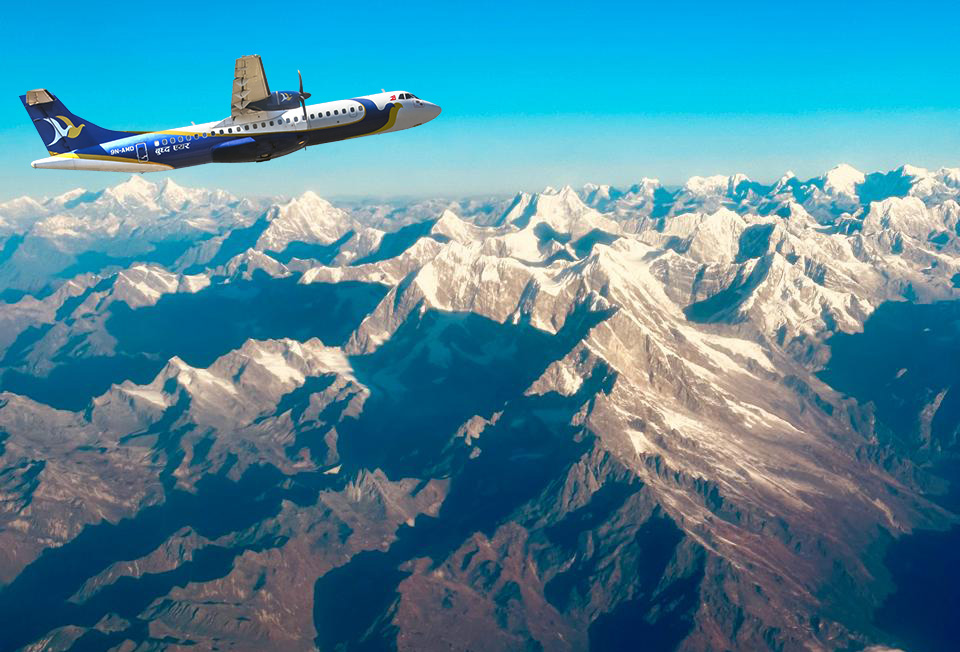
Juphal (Dolpa) Airport sits at approximately 2,475 meters and is the primary access point for both Lower Dolpo and Upper Dolpo treks. Tara Air and Sita Air operate scheduled Twin Otter flights from Nepalgunj — a city in Nepal’s far western Terai — to Juphal. The Kathmandu to Nepalgunj leg is a commercial domestic flight of approximately one hour, followed by a thirty-five to forty-five minute mountain flight from Nepalgunj to Juphal. Total travel time from Kathmandu to Juphal: four to six hours on a good day.
The phrase “on a good day” is doing real work in that sentence. Juphal Airport operates under visual flight rules — no instrument approaches — and the surrounding terrain means that cloud cover, poor visibility, or strong winds can ground flights for multiple consecutive days. Every competent Dolpo itinerary builds two to three buffer days at Nepalgunj for this reason. Do not book an international flight home within five days of your Juphal return date. We build this buffer into every Dolpo package we operate, and we have used it on multiple occasions.
Phoksundo Airstrip
A smaller and more remote airstrip near Phoksundo Lake provides an alternative access or exit point for some Dolpo routes, particularly the Upper Dolpo itineraries that use a different entry and exit. This airstrip is even more weather-dependent than Juphal and is only served by the smallest aircraft. Its use depends entirely on current conditions and is always a secondary option rather than a primary plan.
The Drive Alternative
A rough road now extends into parts of the Dolpa district from the southern access points, and it is theoretically possible to reach Dunai (the district capital) by vehicle from Surkhet or Nepalgunj via a very long and demanding overland journey. This option is not commonly used for trekking itineraries because the road quality and travel time are both substantially worse than the flight alternative. For the standard trekking routes in this guide, the Nepalgunj to Juphal flight is the correct approach.
Wildlife in the Dolpo Region: Snow Leopards and Beyond
Shey Phoksundo National Park is one of Nepal’s most significant protected areas for trans-Himalayan wildlife, covering 3,555 square kilometers of the Dolpa and Mugu districts and spanning altitudes from 2,130 meters to 6,883 meters at the summit of Kanjiroba Himal. The park’s conservation success is measurable: a 2019 to 2022 survey by the Department of National Parks and Wildlife Conservation, supported by the World Wildlife Fund, counted 90 snow leopards within the park boundaries — a density of 2.21 individuals per 100 square kilometers, one of the highest confirmed snow leopard densities anywhere in the world.
For trekkers, the snow leopard sighting probability is real but not guaranteed — the animals are elusive, camouflage-adapted, and active primarily at dawn and dusk. The best chances come from slow, quiet movement on the high plateau above the Phoksundo Lake basin and in the Shey valley approaches, where snow leopard and their primary prey species — the bharal (Himalayan blue sheep), which move in large herds across the open plateau — concentrate. George Schaller’s 1973 survey counted bharal in the thousands in the Shey area. They are still there.
Beyond snow leopards and bharal, the park supports musk deer, Himalayan tahr, ghoral, Tibetan wolf, Himalayan black bear, and red fox. Bird life includes the bearded vulture (lammergeier), Himalayan griffon, golden eagle, and multiple species of high-altitude snowcocks and accentors. The park’s elevation range and geographic isolation have produced a biodiversity more typical of Tibet than of Nepal, and the absence of hunting — maintained both by the national park regulations and by the traditional non-violence practices of some Dolpa communities — keeps wildlife populations genuinely wild and visible.
The Bon Religion: Dolpo’s Ancient Spiritual Tradition
The Bon religion is the indigenous spiritual tradition of Tibet that predates the arrival of Buddhism by several centuries. Founded by the teacher Tonpa Shenrab Miwoche, Bon has its own sacred texts, its own cosmology, its own monastery tradition, and its own ritual calendar — it is not a variant of Buddhism, though the two traditions have influenced each other over the centuries of coexistence in the Himalayan world. In most of Tibet and across most of Nepal’s Himalayan communities, Buddhism eventually became dominant, and Bon survives only in scattered communities. Dolpo is one of the most significant exceptions.
The Dolpa district contains some of the most intact and actively practiced Bon communities in the entire Himalayan world. The Bon monasteries of Dolpo — identifiable to experienced observers by their counterclockwise circumambulation paths, their distinct iconography, and the specific ritual objects and texts on display — maintain active religious communities with genuine continuity from the pre-Buddhist period. The monastery at Ringmo near Phoksundo Lake is Bon. Several of the upper plateau monasteries are Bon. The entire spiritual ecology of Dolpo reflects a world where the older tradition held its ground.
For trekkers, the practical expression of this is an encounter with sacred sites, art, and ritual practice that feels different from the Buddhist monasteries of the Everest and Annapurna regions in ways that are both visible and felt. The murals in Bon monasteries depict different deities in different postures with different symbolic vocabularies. The monks’ robes and ceremonial objects differ. The atmosphere of a Bon monastery at prayer — with its own distinctive chanting tradition, its own instruments, its own approach to the sacred — is unlike anything in the better-known trekking regions of Nepal.
Best Time to Trek the Dolpo Region
The Dolpo region has a more favorable year-round climate than most Himalayan destinations, for the same reason Mustang does: the upper plateau lies in the rain shadow of the Himalayan main range and receives minimal monsoon precipitation. This makes Dolpo one of the few regions in Nepal where summer trekking is both viable and appealing to experienced trekkers.
Spring: April Through June
Spring is the primary trekking season for Dolpo. April and May offer a combination of warming temperatures, good trail conditions after winter, and manageable pass conditions — snow on the high passes (Kang La, Jeng La) is typically consolidated enough by late April to be passable without technical equipment. June remains good on the high plateau, when monsoon weather is building further south but has not yet affected the trans-Himalayan zone of Dolpo. Many Upper Dolpo expeditions schedule their high-pass crossings for late May to early June specifically to use this monsoon shadow window.
Summer / Monsoon: July Through August
Unlike the Annapurna and Everest regions, where monsoon season effectively ends trekking on standard routes, Upper Dolpo remains trekable in July and August for experienced and well-equipped parties. The high plateau receives very little monsoon rainfall. Lower Dolpo and the approach trails from Juphal — which pass through more monsoon-exposed terrain — are more affected, and some river crossings become more challenging with higher water levels. For trekkers with flexibility in their timing, late June through July in Upper Dolpo provides exceptional solitude and the particular quality of summer light on the plateau.
Autumn: September Through November
Autumn is the second main trekking window and the one most commonly used by trekkers coming from the Kathmandu-based agency system. October is the finest month: crisp post-monsoon air, excellent visibility, good trail conditions across all routes, and the most comfortable temperatures for camping at high altitude. November remains good through mid-month. Late November brings very cold nights at altitude and the beginning of early winter snowfall on the high passes.
Winter: December Through March
Winter in Upper Dolpo is severe. Temperatures on the high plateau drop to minus 20 degrees Celsius or lower at night, the high passes are snow-covered and often impassable without mountaineering equipment, and many of the Dolpa communities themselves relocate to lower elevations during the coldest months. We do not operate Upper Dolpo treks in winter. The Phoksundo Lake approach is potentially viable in December for a well-equipped and experienced party targeting only the lower route, but this is not a route we recommend outside the spring and autumn windows.
Why Trek the Dolpo Region with Getaway Nepal Adventure
Dolpo is not a region where operator quality is a preference — it is a safety variable. The remoteness, the permit complexity, the camping logistics, the flight dependency, and the medical evacuation realities of a place where the nearest hospital is a helicopter flight from the plateau all require an operator who has done this before, repeatedly, and knows what happens when things go wrong.
Expeditionary Crew Standards
Our Upper Dolpo departures use expedition crews with specific Dolpo experience — not general-purpose trekking staff reassigned to a demanding route. Our lead guides for Upper Dolpo have personally crossed the Kang La and Jeng La passes and know the specific seasonal conditions, the timing requirements for each crossing, and the contingency options when a pass is blocked or a trekker cannot continue. Our cooks for Dolpo camping treks carry full expedition kitchen equipment and maintain caloric and nutritional standards appropriate for trekkers working at altitude across multiple consecutive days. This matters more in Upper Dolpo than anywhere else we operate.
Flight Buffer Planning
We build two to three mandatory buffer days at Nepalgunj into every Dolpo departure — not as optional padding but as a fixed structural element of the itinerary. The Juphal flight is the single biggest logistics variable in Dolpo trekking, and the trekkers who arrive home on schedule are the ones whose operators planned for delays rather than assuming good weather. We book hotel accommodation in Nepalgunj in advance, maintain current contacts with the airport operations team, and monitor weather forecasts for the Dolpa district during every active Dolpo departure.
Small Group Maximum
Our maximum group size for Upper Dolpo is eight trekkers. The plateau ecosystems of the Dolpo region are genuinely fragile — the high-altitude vegetation, the wildlife, and the water sources all reflect decades of low-impact use by a small number of visitors. Groups larger than eight generate waste management and campsite impact challenges that we are not willing to accept in this environment. Smaller groups also move more flexibly on the high passes, respond more quickly to individual trekker needs, and create a less disruptive presence in the Dolpa communities along the route.
Frequently Asked Questions About Trekking in the Dolpo Region
Q1: How much does the Upper Dolpo trek permit cost in 2026?
The Upper Dolpo Restricted Area Permit costs USD $500 per person for the first 10 days inside the restricted area, with USD $50 per person per additional day thereafter. A 25-day Upper Dolpo Trek — with approximately 20 days in the restricted zone — would carry an RAP cost of USD $500 + (USD $50 × 10 additional days) = USD $1,000 per person. In addition, the Shey Phoksundo National Park entry permit costs NPR 3,000 (approximately USD $22) per person. Total permit cost for a full Upper Dolpo expedition: approximately USD $1,022 to USD $1,272 per person, depending on exact days in the restricted zone. These permits must be obtained through a registered trekking agency — they cannot be self-obtained at the Department of Immigration.
Q2: What is the difference between Upper Dolpo and Lower Dolpo?
Lower Dolpo covers the southern and more accessible portion of the Dolpa district, centered on Phoksundo Lake and the Tarap Valley. It requires only a Shey Phoksundo National Park permit (approximately USD $22) and is accessible to trekkers on a standard teahouse itinerary. Upper Dolpo is the high plateau beyond Phoksundo Lake — Shey Gompa, the Crystal Mountain, the trans-Himalayan plateau bordering Tibet, and the pass crossings that connect them. Upper Dolpo requires a Restricted Area Permit (USD $500 for 10 days + $50/day additional), a licensed guide, a minimum of two non-Nepali trekkers, and full camping expedition logistics. There are no teahouses in Upper Dolpo beyond the lake.
Q3: Is a guide mandatory for trekking in the Dolpo region?
A licensed guide is mandatory for all Upper Dolpo routes — it is a legal requirement tied to the Restricted Area Permit application. Independent trekking in the restricted area is not permitted, and the guide’s certification details must be submitted as part of the RAP application at the Department of Immigration. For Lower Dolpo and the Phoksundo Lake Trek, which use the national park permit rather than the RAP, the guide requirement is strongly recommended but not legally mandated in the same way. Given the remoteness of all Dolpo routes, we recommend a licensed guide on every itinerary regardless of which permit zone you are in.
Q4: What is Phoksundo Lake, and why is it special?
Phoksundo Lake is a high-altitude alpine lake in Shey Phoksundo National Park at 3,611 meters above sea level. At 145 meters deep, it is Nepal’s deepest lake. It was designated a Ramsar Wetland of International Importance in September 2007. The lake’s extraordinary turquoise color comes from its exceptional water clarity and mineral content — the same mineral content that makes it biologically barren, with no fish or aquatic invertebrates. The lake was formed by a landslide 30,000 to 40,000 years ago that dammed the valley, creating a natural bowl. Beyond the lake’s southern edge, its outflow drops 167 meters over Phoksundo Falls. The village of Ringmo, home to Dolpa people practicing a blend of Bon and Buddhist traditions, sits on the ancient landslide dam at the lake’s southern tip.
Q5: What is Shey Gompa, and how do I reach it?
Shey Gompa is an ancient monastery at approximately 4,160 to 4,343 meters on the high plateau of Upper Dolpo, founded in the 11th century and considered the spiritual heart of the Dolpo region. It is adjacent to the Crystal Mountain — a quartz-veined peak sacred to both Bon practitioners and Tibetan Buddhists, circumambulated as a pilgrimage in the same way Mount Kailash is circumambulated in Tibet. Reaching Shey Gompa requires crossing at least one high pass from the Phoksundo Lake side — typically Kang La at approximately 5,350 meters — and is part of the full Upper Dolpo Trek itinerary. It cannot be visited as a day trip from the lake. Peter Matthiessen’s book The Snow Leopard documents his 1973 journey to Shey Gompa and is the work that first brought international attention to this monastery.
Q6: What is the best time to trek in the Dolpo region?
The Dolpo region has a longer viable trekking window than most Himalayan destinations because the upper plateau lies in the rain shadow of the Himalayas and receives minimal monsoon rainfall. The two primary windows are spring (April through June) and autumn (September through November). October is the finest single month for conditions across all routes. Spring offers the advantage of combining good plateau conditions with the pre-monsoon warmth of the approach trails. Summer (July through August) is viable on Upper Dolpo for experienced parties — the plateau itself is largely dry while southern Nepal is in full monsoon. Winter (December through March) is not recommended: the high passes are closed by snow, temperatures on the plateau drop below minus 20 degrees Celsius, and emergency evacuation becomes significantly more difficult.
Q7: How do I get to the Dolpo region from Kathmandu?
The standard access route is: fly Kathmandu to Nepalgunj (approximately 60 minutes by domestic flight), then fly Nepalgunj to Juphal Airport in the Dolpa district (approximately 35 to 45 minutes on a small Twin Otter). Juphal Airport operates under visual flight rules, and weather delays of one to two days are common — particularly in spring when cloud cover over the Karnali region is frequent in the mornings. Every competent Dolpo operator builds a mandatory two to three-day buffer at Nepalgunj into the itinerary. Do not book international flights home within five days of your scheduled Juphal return date. Getaway Nepal Adventure handles all domestic flights, Nepalgunj hotel bookings, and weather monitoring for every Dolpo departure.
Q8: Is Upper Dolpo a camping trek or a teahouse trek?
Upper Dolpo is exclusively a camping expedition. There are no teahouses above Phoksundo Lake on any of the Upper Dolpo routes — no lodges, no staffed guesthouses, no food services. The trekking party carries all tents, sleeping equipment, cooking infrastructure, food supplies, and personal camping gear into and across the plateau. A full expedition crew — cook, kitchen assistant, experienced guide, and porters — is mandatory for Upper Dolpo. All Getaway Nepal Adventure Upper Dolpo packages include the complete camping infrastructure. Lower Dolpo and the Phoksundo Lake Trek use teahouses where available and supplement with camping only in sections where there are no lodges.
Q9: What wildlife might I see in Dolpo?
Shey Phoksundo National Park has one of the highest confirmed snow leopard densities in the world — a 2019 to 2022 survey counted 90 snow leopards within the park at a density of 2.21 individuals per 100 square kilometers. The bharal (Himalayan blue sheep), the primary prey species of the snow leopard, moves in large herds across the open plateau above Phoksundo Lake and in the Shey valley — they were counted in the thousands by George Schaller during his 1973 survey and remain abundant. Other wildlife includes musk deer, Himalayan tahr, Tibetan wolf, ghoral, Himalayan black bear, bearded vulture (lammergeier), golden eagle, and Himalayan griffon. The absence of hunting — maintained by both park regulations and traditional Dolpa values in some communities — keeps animal populations genuinely wild and visible.
Q10: What books and films can I read or watch before trekking Dolpo?
Two works are essential preparation for any Dolpo trek. The Snow Leopard by Peter Matthiessen (1978) documents his 1973 journey across the Dolpo plateau to Shey Gompa with naturalist George Schaller. It won the National Book Award and is widely considered one of the great works of American nature writing. It will change how you experience the plateau. Himalaya (also titled Himalaya: L’Enfance d’un Chef / Caravan) is a 1999 French film directed by Eric Valli, shot almost entirely on location in Dolpo with a cast of Dolpa people playing fictionalized versions of their own lives. It was nominated for the Academy Award for Best Foreign Language Film. The landscapes in the film are accurate — the passes, the plateau, the faces, the yak caravans. Watching it before departure will give you a visual vocabulary for what you are about to experience.
Top Add-on Trips
Everest Base Camp Helicopter Tour
Monastery Stay Tour